

It is impossible to say how many Taliban there are in Afghanistan today, and the numbers have varied considerably since the regime that ended the US invasion in 2001. According to different studies, it is believed that there are around 60,000 combatants, 20% above or below, which would leave this figure between 48,000 and 72,000. Last July, close to the end of the withdrawal of US soldiers, President Joe Biden estimated the number of combatants at about 75,000 ; However, the most systematic public study of the size of the Taliban forces, published in 2017, concluded that the insurgent group had more than 200,000 members.: about 60,000 combatants, some 90,000 members of local militias and tens of thousands of facilitators and support elements.
With these figures on the table, the 20,000 fighters that the United States spoke of in 2014 were far behind. But with those that exist, they have taken control of Afghanistan: in just 10 days they managed to take 26 of the 34 provincial capitals , and the August 16 culminated the insurgent operation with the seizure of Kabul, the capital , after the departure of President Ashraf Ghani from the country and leaving behind a trail of chaos at airports and borders, with thousands of Afghans trying to leave. the country. With the commitment to maintain a " general amnesty"For all senior officials in the fallen government, the Taliban assure that they will be in charge of maintaining control and security of the country, and guaranteeing rights for all, including women ... with reservations: as long as they abide by Islamic rules .
Taliban hierarchy
The current structure of the Taliban is deeply uneven, although the top brass are more or less defined. The maximum leader, since May 2016, is Haibatulá Ajundzada , who during the Taliban regime of 1996-2001 was Chief of Justice, the main person in charge of the application of 'sharia' or Islamic law in Afghanistan. At his side are several 'number twos', each one in charge of a strategy: military, politics, peace talks ...
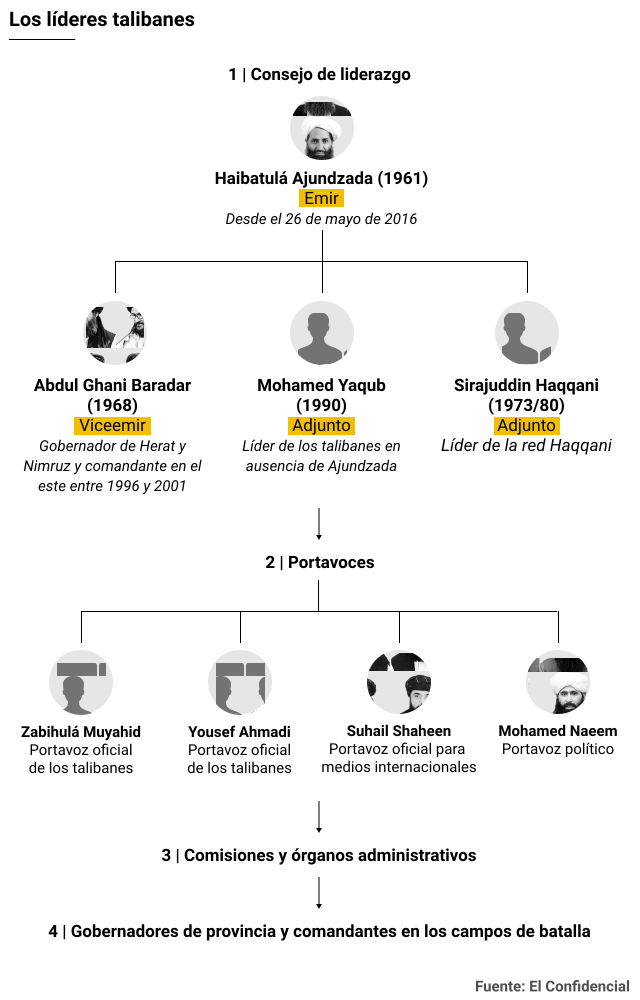
Ajundzada was a close associate of Mohamed Omar, founder of the Taliban in the 1990s and leader of the Mujahideen until his death in 2015. Following the death of Mullah Omar, he was replaced by Ajtar Mohamed Mansour, who was killed in a US attack in May 2016 . It was here that the Taliban announced Ajundzada as Emir-ul-Mominin Sheikh ul Quran, commander of the believers and Quran scholar , leader of the Taliban. According to expert from the Afghanistan analyst network Thomas Rutting, Ajundzada is part of the "old generation", which is why he had the respect of the Taliban, and given his age, older than Haqqani or Yaqub, he was a better fit. The charge.
► Abdul Ghani Baradar, negotiator in Qatar
Co-founder, along with Mohamed Omar, of the Taliban in southern Afghanistan, he was born in 1968 in the province of Uruzgan. During the eighties he fought against the Soviet invasion in Kandahar , where he later operated, also together with Omar, a 'madrassa' or Islamic school. Several media claim that before founding the Taliban insurgency Omar and Baradar became a family, by marrying two sisters. Considered a 'moderate' within the Taliban leadership, he entered it being almost an unknown at the international level, but with the necessary ingredients to be a great boss. " It has all the military, political, religious and financial power, " he explained to 'Newsweek' Mullah Shá Wali Ajund in 2009, when Baradar was the' de facto 'Taliban leader. Already during the 1996-2001 Taliban regime, Baradar had been governor of Herat and Nimruz, as well as commander in the west of the country.
His charisma, skills, and knowledge of the Afghan terrain and people make him a "formidable enemy," according to Professor Thomas Johnson, an expert on Afghanistan and a professor in the Department of Homeland Security at the Monterey Naval Academy, California, also director. from the Conflict and Culture Studies program. As early as 2009, Baradar presented himself as a loyal lieutenant, on the orders of his boss, Mullah Omar . Between 2004 and 2009, he was the one who promoted several attempts to open negotiating tables and has participated in a large part of the peace talks.


In 2010, Baradar was arrested in Karachi, Pakistan, in a joint operation by US Intelligence and Pakistani forces. The then also number two of the Taliban was already linked to Osama Bin Laden, the most wanted terrorist , who was hunted three months later, also in Pakistan. In November 2012, Pakistan and Afghanistan signed an agreement in which the former pledged to release a number of Taliban prisoners, including Baradar himself, although he was later excluded from that list. In 2018, his release from prison was finally announced, at the time when he was appointed head of the Taliban diplomatic office in Doha (Qatar): The United States then assured that Baradar's release, in a Pakistani prison, had been able to take place thanks to the mediation of Washington.
Months before taking Kabul, Baradar insisted on his intention to establish an Islamic Emirate in Afghanistan , in order to end the "conflict" in the country. "Each nation aspires to live a life according to its own principles and values, and without fear of threats, invasions and attacks. Our struggle for the last 19 years in Afghanistan has been carried out to achieve that," he wrote in an open letter sent in February. " The Islamic Emirate of Afghanistan is sincerely committed to finding a political solution to the current conflict, "he said in the letter, in which he insisted that the United States fulfill the agreed commitment to leave Afghan soil. It was Baradar who sealed a non-aggression agreement with Donald Trump's Washington in the process of withdrawal of the Although it was seen as another step towards peace, it was nothing more than a turning point, the beginning of the victory of the Taliban.
► Mohamed Yaqub, military chief and son of Omar
He is one of the two deputies to Ajundzada, but he is also the son of the founder of the Taliban , Mullah Mohamed Omar. Like Baradar, Yaqub is part of the 'moderate' wing of the Taliban and has in the past shown his position in favor of a liberalization of social policies and a negotiated solution to the Afghan conflict. Virtually unknown until the Taliban confirmed the death of their leader, Mullah Omar, Yaqub was in charge of denying the rumors about the death of his father - there was talk of a possible internal adjustment, but he confirmed that he had died of illness - and, with only 20 years (now he is just over 31) , called for unity within the Sunni group. He was first appointed deputy leader, to which was added the position of military leader of the Taliban , although not without reluctance within the insurgency, mainly due to his inexperience on the battlefield.
However, being the son of the founder of the Taliban and his charismatic character have not served to earn him respect. As explained by a senior Afghan Intelligence official on condition of anonymity to RFE-RL , Mullah Yaqub is nothing more than "a cunning young man, who is believed to have certain privileges and is somewhat self-centered" and, having been raised outside the country, "does not know the reality of Afghanistan ." The young son of Mullah Omar is also located in Pakistan, where he could have received training from the Islamist group Jaish-e-Mohammed, outlawed since 2002, which operates in disputed Kashmir.


In May 2020, in the absence of Ajundzada, who contracted covid-19 - it was even said that he had died from the coronavirus - it was the young Yaqub who was left in command of the Afghan Taliban. "Our hero, the son of our great leader, Mullah Yaqub, is directing the entire Taliban operation in the absence of Haibatullah," Ulema Mohamed Ali Khan Ahmad announced at the time to 'Foreign Policy'. It is known that the son of the founding mullah has ties with Saudi Arabia, who could be financing him to help him consolidate power, and also with the already fallen Government of Kabul and the Afghan intelligence services, to facilitate an eventual peace agreement. . In addition, Taliban sources from Quetta (Pakistan) assure thatHis figure has helped to grow income for the insurgency , reaching an annual income of 1.7 billion dollars, although this figure has not been confirmed.
► Sirajuddin Haqqani, leader of the Haqqani network
If the first two are considered to be from the 'moderate' wing of the Taliban, Sirajuddin Haqqani must be placed in a somewhat tougher branch. Following Mansour's death in 2016, Haqqani, the son of Mujahideen Jalaluddin Haqqani, could become the leader of the Afghan Taliban . Responsible for a multitude of Taliban attacks, including the kidnapping of the then journalist of 'The New York Times' and current editor of 'The New Yorker', David Stephenson Rohde, in the hands of the Taliban for more than seven months - a period during which asked that his disappearance not be reported - Sirajuddin Haqqani's head comes at a high price:
Both the United States and Afghanistan have called him the insurgency's most dangerous warlord. He entered the Taliban leadership council as the leader of the Haqqani network , previously led by his father. His father, in fact, was financed by the CIA and Pakistani Intelligence (ISI) during the Soviet-Afghan war of the 1980s. Just over a year ago, Sirajuddin Haqqani published a column in 'The New York Times' titled " What We Taliban Want"in which he lamented the thousands of deaths that the war in Afghanistan has claimed, where he insisted on the need for American soldiers and all foreign forces to leave the country and showed his confidence in reaching" the way to build a system where all Afghans have the same rights, where the rights that Islam guarantees for women , from education to the right to work, are protected and where merit is the basis for equal opportunities. "
All of them are part of the Leadership Council, also known as Rahbari Shura or Quetta Shura, in homage to the Pakistani city where Mohamed Omar is believed to have taken refuge, along with his collaborators, after the US invasion. The council is the body from which the main decisions are made for all political and military affairs of the Emirate , according to the United Nations Assistance Mission in Afghanistan (Unama). This body has been led by the Taliban emir, Ajundzada, since 2016, but before him Omar and Mohamed Mansour did.
This body is in charge of supervising different commissions , equivalent to what would be the ministries of the Emirate, which already existed before 2001, when the US invasion ended the departure of the Taliban from the Afghan government, and ranging from economy to education, passing for health or disclosure. Also the Rahbari Shura controls the different administrative bodies, through which the Taliban operate, until now, a shadow government. One of the commissions, specifically the military, is the one in charge of appointing governors in each province and battlefield commanders in the 34 provinces of the country. Baradar, in addition to being behind the peace negotiations with Qatar, is the head of the political commission, whose headquarters so far have been in Doha.
Without power, but with information
While the Taliban have a multitude of spokespersons, not all of them are known. Officially, there are two spokespersons at the general level of the insurgent group: Zabihulá Mujahid and Yousef Ahmadi, of whom there is not much information. Of the first, it is not even known if it is his real name or an alias , although the Afghan journalists with whom he usually contacts say that he speaks Pashto with an accent from the east of the country. Afghan Intelligence believed, about 10 years ago, that it was actually Hajji Ismail, a Pakistani in his 40s, although he himself claimed then that his real name was Zabihulá, who was a fugitive in Afghanistan. At that time, he changed his phone frequently - he changed his number every two weeks and sent messages from the new one - and he always signed as Z_M or Z_Muyahid.
In 2009, CNN reporter Nick Robertson interviewed him. Without showing his face, he explained that he was about 30 years old, had a beard - although not much - thin and would measure six feet, approximately. At that meeting they discussed how to win the war ("We believe in negotiation, but also in war"), and the Taliban spokesperson did not deny the use of suicide attacks, regardless of whether civilians were killed as a result, although warning of this. ("We ask civilians not to approach Western soldiers, not to be targets of attacks"), how the peace talks were stalled then and their ties with Al Qaeda("We are not under their command, but some come to fight and we welcome them"). Even so, there are experts who consider that Zabihulá Mujahid is not a single person, but several individuals who use the same identity over time.
He assures that he lives in Afghanistan, although never in the same place, for security reasons. He does not give many details either, although he claims to be married with several children. According to an anonymous source from the United States to 'The New York Times', none of the spokesmen have lived in the country , especially since the fall of the Taliban regime. They say that Mujahid held a low-level position in the Department of Culture and Information during the five years that the Taliban were ruling with an iron fist in the country, and assures that before being a spokesman he fought alongside the insurgency.
In 2012, spokesman Ahmadi inadvertently released a full Taliban contact list
The other is Yousef Ahmadi , to whom the term 'qari' is sometimes added before the name, which refers to those who recite the Qur'an following the rules on pronunciation and recital that the so-called 'tajwid' includes. Ahmadi also does not have a profile photo, nor is his face known, although it is known that his work is concentrated in the western and southern parts of Afghanistan. One Saturday, November 16, 2012, Ahmadi prepared to send out a press release that he had received from his partner, Zabihulá Mujahid. Instead of using the BCC feature (or BCC, the 'blind copy' feature), which keeps the email addresses to which the message is sent private, the spokesperson made public the identities and emails of the entire list .
There were about 400 names who received that communication and whose identities were made public. "The Taliban have put my four email addresses on a leaked distribution list. Very reassuring for my safety, " wrote journalist Mustafa Kazemi who, at the time, had just 10,000 followers - today, he says. with more than 116,000 and works for RFE-RL—. In addition to journalists, there were the email addresses of a provincial governor, a legislator, several academics and activists and even a spokesman for Gulbudin Hekmatiar, a former warlord, genocidal and known as 'the butcher of Kabul' for his participation in the Afghan-Soviet war.
Both Ahmadi and Mujahid's predecessor - Mohamed Hanif, arrested in 2007 and assassinated the following year - were appointed spokespersons for the Taliban in 2005 . Ahmadi replaced Latifulá Hakimi, responsible for claiming responsibility for a suicide attack in January 2004 in which the Taliban killed a British soldier in Kabul. Hakimi was arrested by Pakistan in 2005, when Ahmadi replaced him, but he was released from prison two years later along with other Taliban prisoners, a release that was approved in exchange for the Taliban releasing Italian reporter Daniele Mastrogiacomo, kidnapped in Helmand. The Taliban then said that the journalist had confessed to being a spy for the United Kingdom, although 'La Reppublica', the newspaper for which he had worked since 1980, denied it.
Spokespeople with faces
Meanwhile, there are other spokespersons who are publicly known. Suhail Shaheen is the Taliban spokesperson for international media. He studied at Kabul University, is fluent in English, and is a prolific writer. During the Taliban regime (1996-2001), he was the editor-in-chief of 'Kabul Times', an English-language state newspaper, before being appointed Deputy Ambassador to the Afghan embassy in Pakistan. After the capture of Kabul, Shaheen called directly to the British channel BBC , where he explained live that the Taliban want a "peaceful transfer of power", that "there will be no revenge for anyone" and that both the Afghan people and their lives and property are "safe" with the Taliban in power.
Shaheen is also the one who has been in charge of ensuring that all girls and women will be able to continue studying and accessing higher education with the country under his control. "We have announced this policy more than once (...). In all those areas that are falling on our side in Afghanistan there were thousands of schools, girls' schools, universities. All of them are operating," he said. "They can have positions, but they can occupy those positions in the context of Islamic law , so there is a general framework for them," said the Taliban spokesman, who stressed that women should be covered according to "Islamic norms", but that his garments "are not limited to the burqa." During the previous Taliban regime,as doctors or nurses in certain hospitals and did not have access to education, among many other restrictions directed only at the female population.
Mohamed Naeem is the only other Taliban-faced spokesman . In charge of information for the insurgent group's political office, Naeem is relatively active on social media - he has more than 200,000 followers, Shaheen just over 345,000 - and has worked from his office in Qatar, at the headquarters of the political office. Naeem has been in charge of making public the arrival of Baradar and the rest of the Taliban delegation from Qatar to Kandahar (Afghanistan), where they landed on Wednesday afternoon to, predictably, officially declare the Islamic Emirate of Afghanistan.